

It is finally happening: registration is open and Chronicle Keeper 1.0 is public. Writing that feels great and a little strange at the same time. After all, “version 1.0” is about as final for a hobby project as a role-playing group's plan to actually start on time for once.
For me, 1.0 does not mean every idea is finished and every rough edge is gone. It means Chronicle Keeper has reached a point where I can open the door with a clear conscience and say: come in, put your Realm on the table, and give it a try.
Before I tell you what it has become, I want to thank my friends. For years they have fed Chronicle Keeper with Realms, Campaigns, broken workflows, very specific wishes, and wonderfully honest feedback. Without their patience, this would probably still be a slightly overambitious document search running on my computer.
If you mainly want the plain list of new features, you can find it in the version 1.0 changelog. Here I would rather tell the story behind it.
It started with a Dungeon Master and OneNote
The real reason for this project was that my Dungeon Master was going mad with his OneNote. Of course there are many better notebooks, wikis, and campaign tools today. Back then it was OneNote – and the important piece of information was always inside the exact notebook, section, or subsection where nobody was looking.
The problem was not a lack of notes. The problem was that a role-playing Realm that has grown over many years is more than a stack of text pages. Characters know places, factions follow goals, old World Events explain new conflicts, and a name mentioned eight months ago is suddenly very important today. Keeping all of those connections alive in an ordinary notebook is hard work.
As a software developer, I obviously could not ignore such a good excuse for a new hobby project. You could also say I saw my friends suffering and answered with several years of additional work for myself. A completely sensible decision.
The first version was small. Store Documents, search content, find knowledge again. Then one problem followed another, and every problem made the same thing more obvious: Chronicle Keeper should not only manage notes. It needs to understand the structure of a Realm.
Two years with one character, eight days in his Realm
I do not only use Chronicle Keeper as its developer. I use it as a player too. Our Dungeons & Dragons game takes place in an entirely homebrew Realm. It borrows a few things from Dungeons & Dragons, but when I forget why a certain family has a bad reputation in a certain city, Google is not much help.
After every Session I continue my character's journal and add the knowledge he actually discovered to his Compendium. That distinction matters to me. My own meta knowledge can become blurry over time. For my character, I want to look up who he met, what he learned about a place, and why turning his back on one particular faction may be a poor life choice.
A small role-playing fact on the side: I have played this character for more than two years. During that time, only eight days have passed in his Realm. He now remembers far more details than I do, which is a little rude considering I am the one playing him. Chronicle Keeper helps both of us.
A document search became a Realm
Today, the Compendium is the heart of Chronicle Keeper. Documents and Images live there beside the World Entities of the World Atlas: people, places, factions, or whatever other types your own Realm needs. Campaigns, Quests, and Whiteboards have their place there too. Folders, categories, and tags stop a long chronicle from turning into a digital attic.
Around it are tools with their own jobs. The Realm Calendar tracks time in your fictional Realm. Sessions record what your real group planned and played. Search and the Command Palette take you quickly to the right content. Conversations are where you work with the Keeper. And the World Graph shows the connections that have quietly grown between all those entries.
This is starting to sound suspiciously like a product list – and, yes, it is a little bit. But behind it is still the same simple question I had at the start: how do I return to exactly the knowledge my group needs, even years later?
Connections instead of piles of notes
That is why Relationships and World Events matter so much to me. A Relationship describes a current fact: Brother Calder lives in Greyhaven, or Lady Seraphine Vale belongs to a certain house. A World Event records what happened: who joined the ambush, which Role a faction had, and on which In-world Date it took place.
Documents, Images, and Whiteboards can provide Evidence. Campaigns, Quests, Sessions, and Calendar events provide play context. This keeps more than the claim itself. It also keeps where the claim came from and why it mattered to your story.
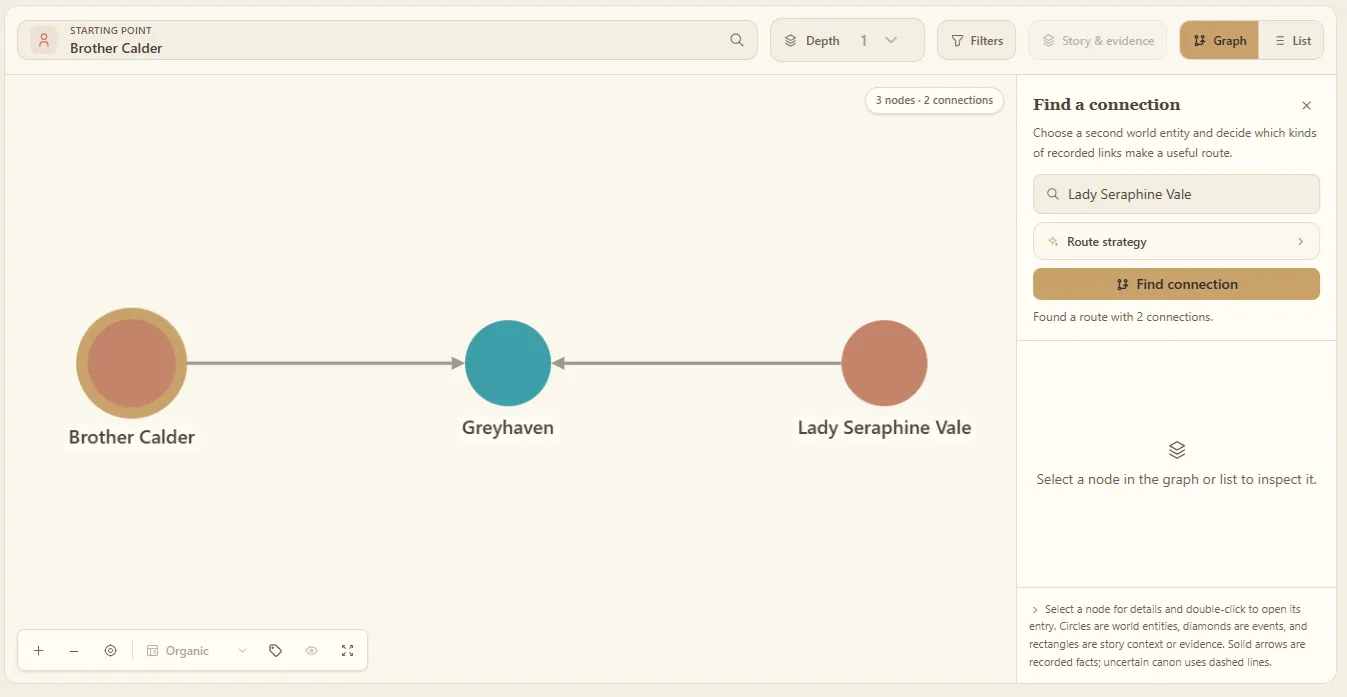
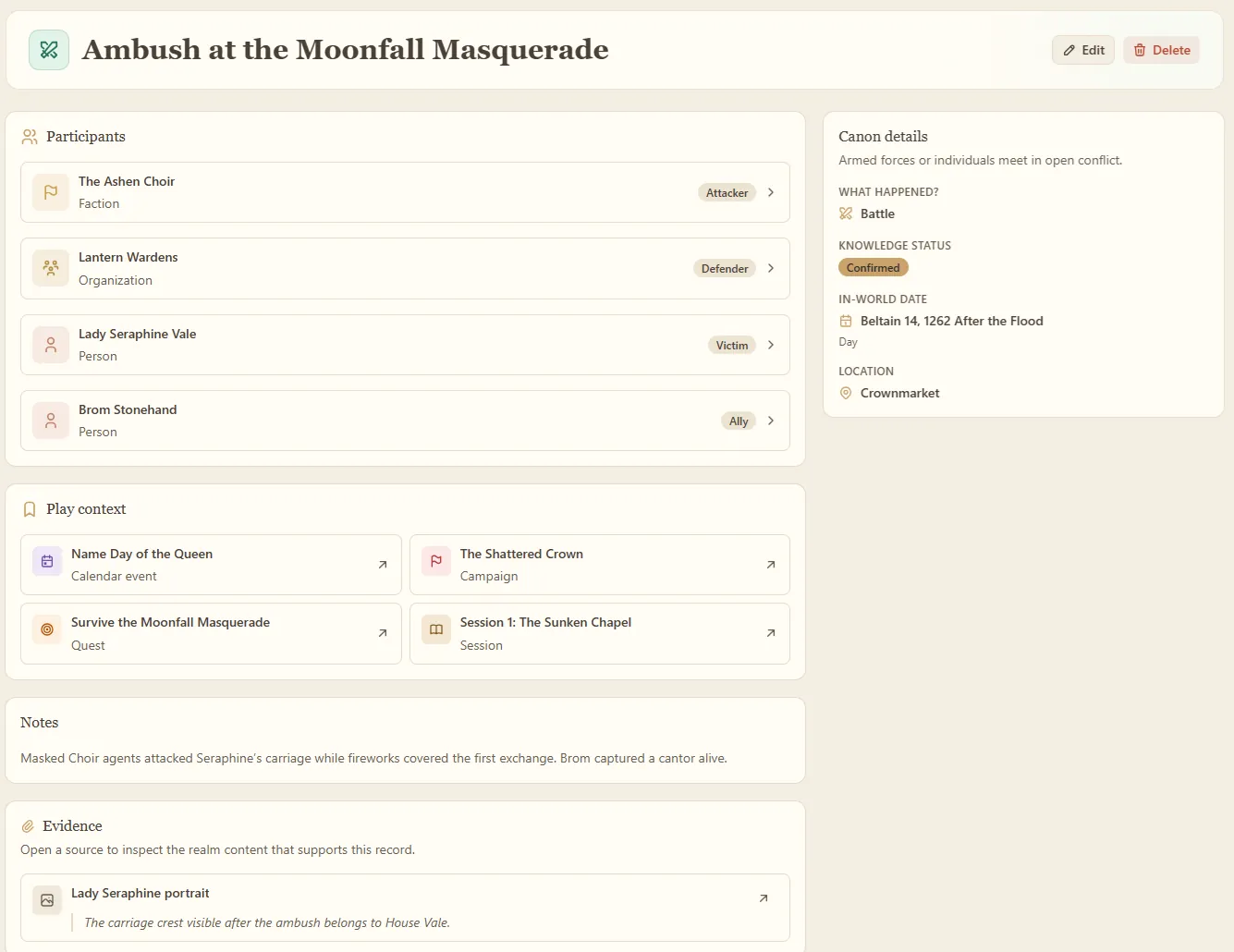
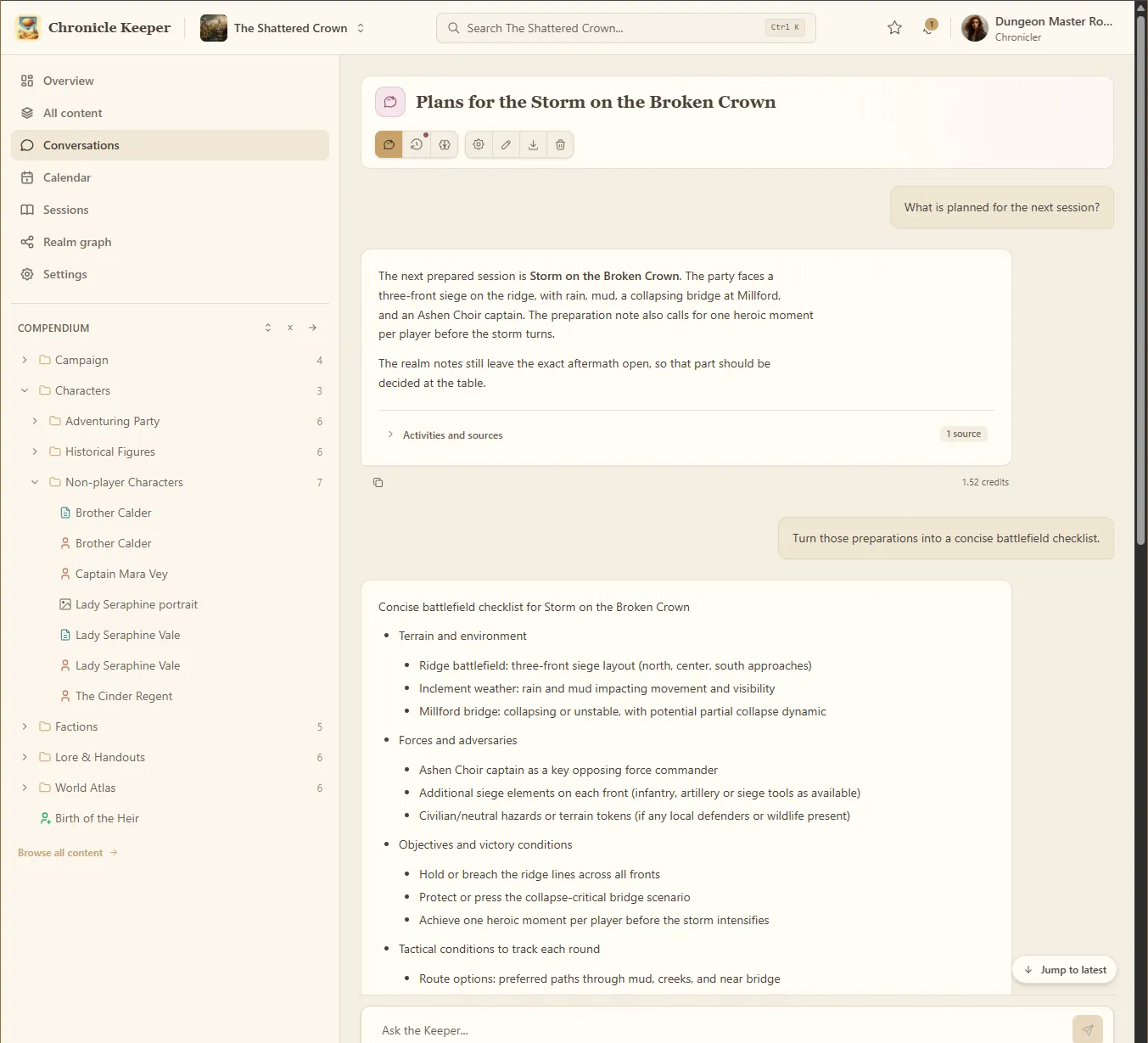
These three views contain a lot of what Chronicle Keeper should be for me: write knowledge down, keep its origin, discover connections, and turn it back into something useful at the table.
The Keeper should know your Realm, not replace it
Then the age of artificial intelligence arrived, and the small document finder finally became something I had never planned at the beginning. The Keeper is an AI-backed librarian working with the recorded content of your Realm. It can find and summarise knowledge, show sources, help with preparation, or point out open questions.
It should not be a generic chatbot wearing a fantasy hat. Its answers should come from your Realm. And when it suggests new ideas, they do not secretly become canon. You decide what to keep. The Keeper can help you think, but the decision about what is true in your Realm still belongs to you and your group.
AI features are optional and, for now, enabled on request through Discord. Unlike the rest of the service, they create noticeable running costs. Just message me there, tell me a little about your group, and give me honest feedback later. We can usually find a way – just without a promise that this access can stay unchanged forever.
Free, because it is a passion project
Chronicle Keeper is, first of all, my hobby project. I use it to learn and to share my almost 30-year passion for role-playing games in all their shapes and colours. That is why registration is open and getting started without AI features is free.
As long as a few million people do not suddenly decide to store their Realms here at the same time, I can and want to carry the basic running costs. Charging for AI access would quickly turn the hobby into a much larger organisational and legal project, though. I do not want to force that step right now. Maybe this will become a community association or another community-backed model one day. Maybe we will find a completely different solution. We will see.
I am always happy about lively conversations on Discord, and of course about a coin dropped into the tip jar. Both help, but neither is an entry ticket. Even more important to me is learning how Chronicle Keeper works at real tables, where it helps, and where it still gets in your way.
Version 1.0 is not the finish line
My list of ideas is still longer than the average adventurer's equipment list. Some things on it are:
- expand Content Sharing so copies and synchronised content can be distributed more precisely
- publish selected content or whole Realms with clear control over what becomes public
- make searches within very long texts more relevant
- suggest short adventures or Quests grounded in the existing knowledge of a Realm
- find possible Relationships in texts and offer them as suggestions for review
- and, of course, the ideas and wishes that only appear when your groups use the product
This is not a fixed roadmap, and certainly not a promise with a date. It is the direction in which I would like to keep thinking. Which ideas truly matter will not be decided in my notebook. It will be decided by the people using Chronicle Keeper.
Here's to the next stories
I hope you will have as much fun with Chronicle Keeper as I do. Build a Realm, continue your character's journal, plan a Session, or ask the Keeper why that one faction was angry with you again. You probably had a very good reason. Probably.
For me, version 1.0 is mainly an open door. Try Chronicle Keeper, bring your stories, and tell me what is missing. If this grows into a tool that helps a group find its shared Realm again even after many years, the whole journey has been worth it.